Khamal, a visually impaired student in his final semester of Informatics Engineering at Pamulang University in South Tangerang, has always carried a deep sense of determination. His thesis focuses on disability rights, and alongside his studies he works part-time, testing accessibility in public spaces - from building structures and transportation systems to the usability of roads. Through his work, Khamal advocates for a world where blind and visually impaired people can move with dignity and independence.
Yet, before joining the Trustbuilding Program (TBP), Khamal struggled internally. Though confident in his own abilities, he often worried about how others perceived him. He feared rejection - not only because of his disability, but also because of differences in religion and belief. Society, he noticed, was often slow to accept disabilities as a natural part of human diversity. Despite knowing in his heart that all people are equally God’s creation, these doubts sometimes weighed heavily on him.
The TBP experience became a turning point. For the first time, Khamal found himself in an environment where he was not just accepted but welcomed wholeheartedly. His enthusiasm and active participation were embraced by fellow participants and the organizing committee alike. One of the most transformative moments for him was during the Relationship Map session. Here, he reflected on his connections with people around him - recognizing where trust was strong, and where healing or growth was needed.
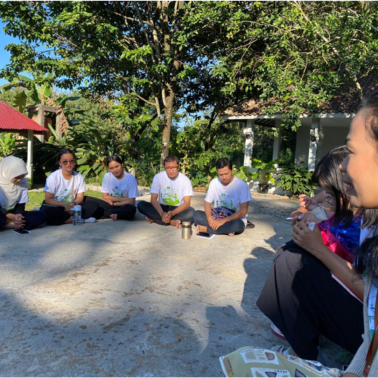
He also found great meaning in the Indonesian Social Context session, where he explored what it means to live as part of a non-dominant group. Far from feeling excluded, he discovered that his voice mattered. In his small “family group”, Khamal experienced genuine listening and non-judgmental dialogue - something that gave him the courage to share more openly than before.
After TBP, Khamal emerged with renewed confidence. He proudly represented disability in a space where, perhaps, he was the first participant with such lived experience. Through conversations with peers, he also gained valuable insight into how non-disabled people perceive disability - knowledge that strengthened his own advocacy. More than that, he built friendships across different faith traditions, broadening his perspective and even learning about Buddhism for the first time.
Today, Khamal stands as a voice for inclusion and trust. His journey through TBP did not just affirm his self-worth; it empowered him to bridge divides - between disabled and non-disabled communities, and between people of different beliefs. His story is one of transformation: from worry to confidence, from isolation to belonging, and from difference to shared humanity.